Slot-based Driving
Project Overview
Implementation of slot-based driving on a platoon of autonomous robots.
Introduction
Sustainable transport depends on predictable journey times. Public transit, shared mobility, and on-demand delivery all need reliability to compete with private car ownership. Today we can't guarantee journey times, because congestion is fundamentally unpredictable: vehicles compete for the same road space in real time. What if, instead, road space could be actively managed, with vehicles assigned a specific place and time on the road, rather than left to negotiate for it?
What is Slot-based Driving (SBD)?
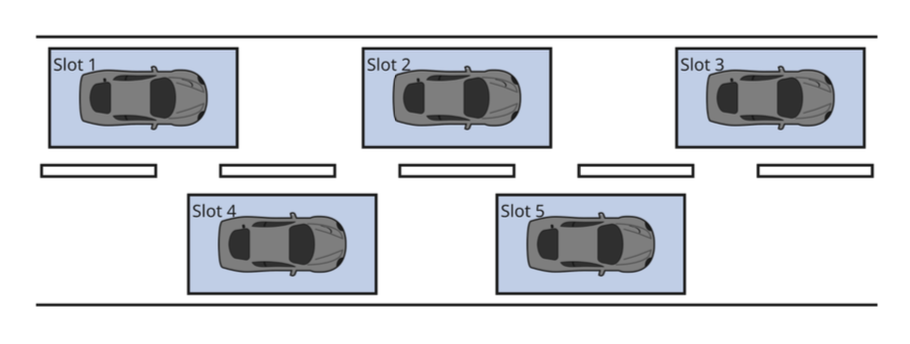
SBD abstracts traffic as a flow of "slots", each with a defined trajectory and speed, which a central controller assigns to individual vehicles. It's similar to air traffic control: where pilots communicate with the centralised ATC tower rather than negotiating directly with each other. Because the controller has a global view of the system, it can make better informed coordination decisions no individual driver could make alone.
The Research Question
SBD had only ever been explored in simulation. Moving it onto physical hardware introduces problems simulation ignores: noisy sensors, communication latency, and imperfect actuation. This thesis set out to answer:
Can SBD be feasibly implemented on physical robots, demonstrating coordinated manoeuvres under real-world constraints?
Approach
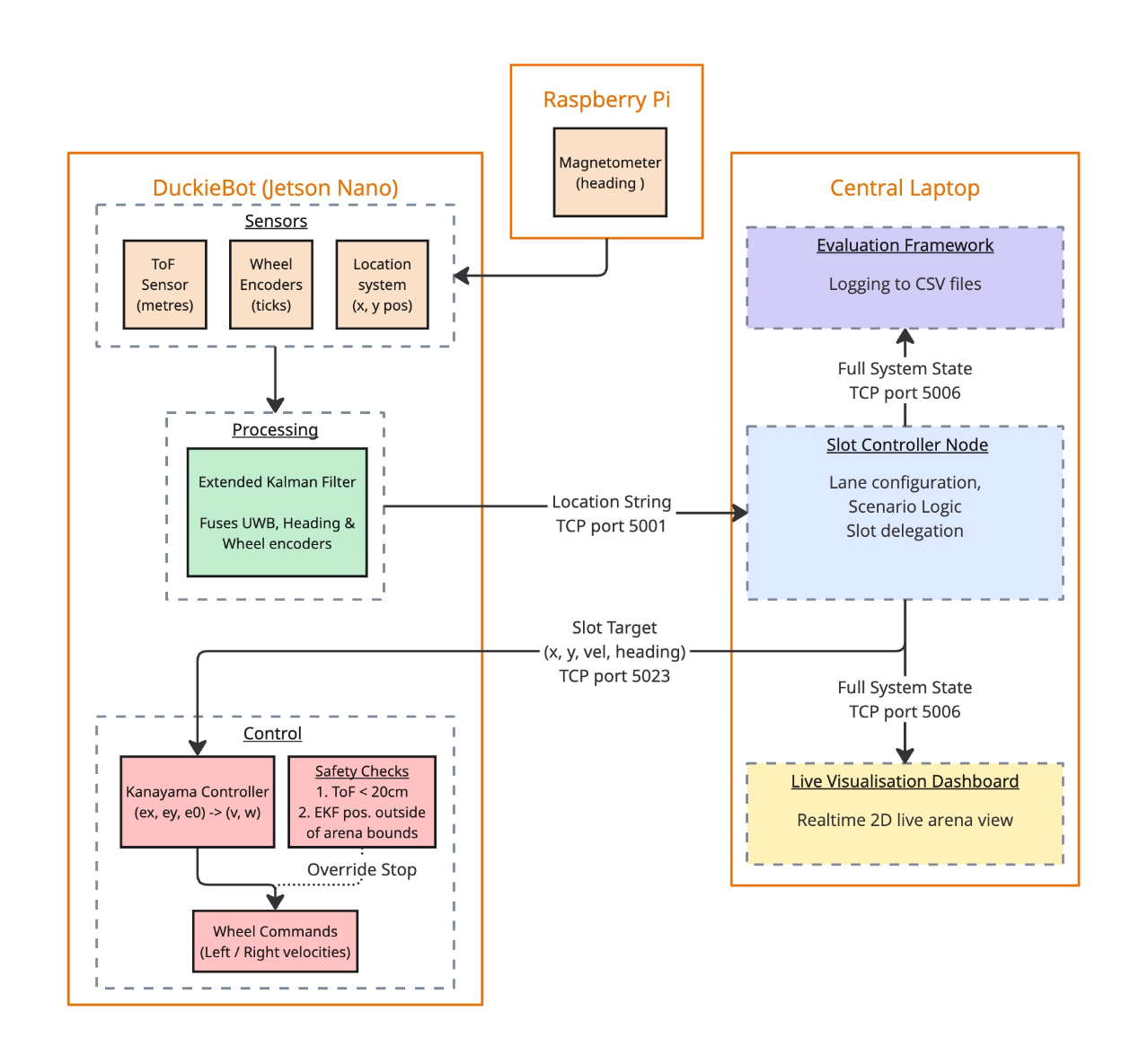
To answer this, I built a physical testbed: a 2.6 m × 1.9 m indoor arena with two physical robots tracked by an Ultra-Wideband (UWB) real-time location system (RTLS). A central laptop controller generated moving virtual slots and assigned them to each robot over TCP, while an onboard Extended Kalman Filter fused UWB, magnetometer, and wheel-encoder data so each robot could localise itself reliably and mitigate sensor noise. A kinematics controller then tracked each robot against its assigned slot in real time. I designed five progressive experimental scenarios; from baseline tracking, through sensor-degradation resilience and individual manoeuvre primitives, to full coordinated multi-robot obstacle avoidance; to test the system incrementally, from a single robot following a slot to two robots resolving a conflict together.
Hardware Used
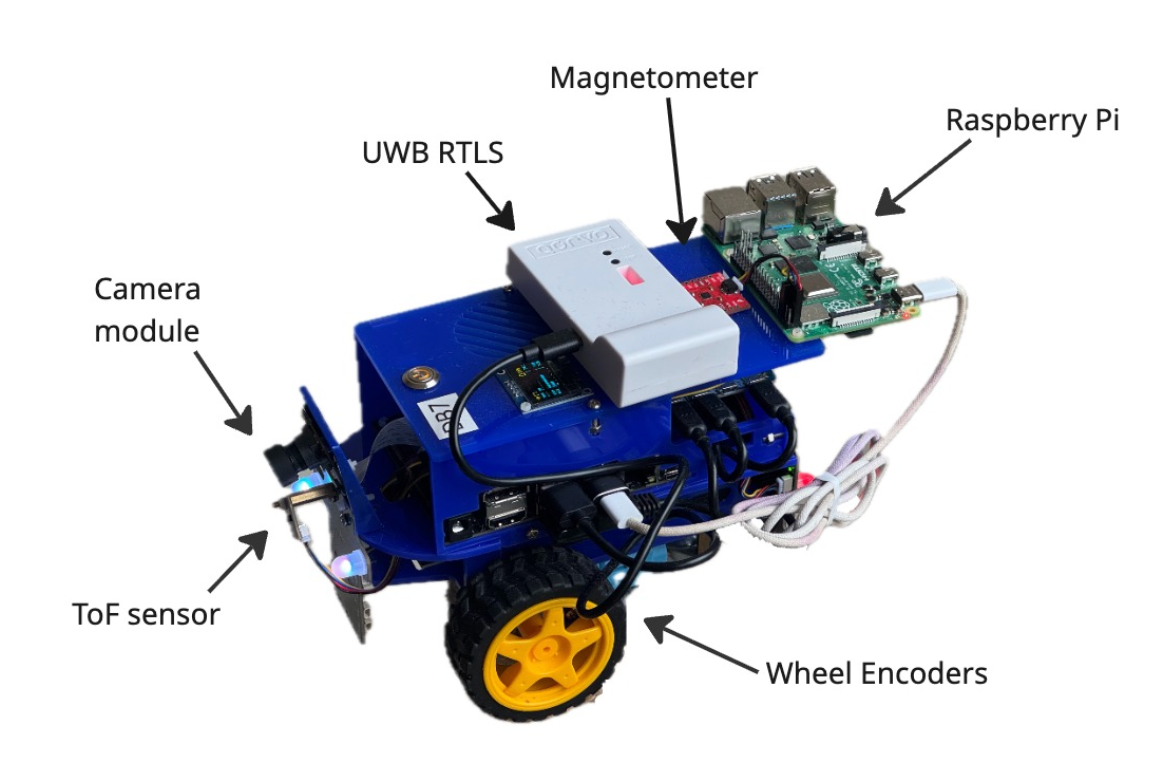
This thesis used two Duckiebot DB21J robotics platforms, small-scale differential-drive robots built around a Jetson Nano. An Ultra-Wideband (UWB) Real-Time Location System (RTLS) tracked the real-world x, y coordinates of each robot, fused with an onboard magnetometer and wheel encoders.
System Architecture
Technical Skills & Technologies
Delivering this project end-to-end involved: